On Friday, we headed for Coba. We had another rainy day walking through the trees. It's hard to complain with such beautiful scenery.

The ruins in this area are BIG. There are several large structures, and our guide told us there are many more in this city hidden in the jungle. Coba was settled between 100 BC and 100 AD and was a thriving city until somewhere around 1000 AD. At its peak, it was thought to have 50,000 inhabitants, although it could have been much more than that.

There were some taxis,

perfect for transporting Dad (and Kim to keep him company).

Many of the trees in this area have camouflage-y trunks, due to the extremely high calcium in the ground water.

I saw several of these nest in the trees, and decided they were home to some exotic jungle bird. Nope. They are termite nests.

Our guide for the day.

This tree looks like someone is tapping it for maple syrup.

It's actually a waxy doorway, made by local bees. The bees of the area are unique--they don't sting. Our guide says they make unusually tasty, expensive honey.

This is the Mayan ball court. Some of the courts were flat, but this one is slanted (said Captain Obvious). The Mayans used a hard ball made of layers and layers of rubber, weighing around 9 lbs. They could hit it with their elbow, hip, shoulder, knee.

The idea was to get it through the hole. You got points for certain achievements, and could win by never getting the ball through the hole. The understanding of this game has changed radically over the years. The Spaniards thought it was a gambling game, but recently archeologist have determined it was a deciding game--if you could get the ball through the hole, it was a good day to go to war, for example. Think of it like Biblical casting lots. It was also once believe the captain of the winning team or the captain of the losing team was sacrificed at the end of the game, but our guide says this is no longer the belief. The ring looks an awful lot like an old Firestone tire.

A detail at the ball court.

Also at the ball court.

This stone stele had a variety of pictures in little rectangles. It was a record of important events, each rectangle a picture representing something significant.

They are constantly finding stone steles in the area.

Coba was also very famous for its road system. It had miles and miles raised highways made of stone and plaster, connecting the city to other cities and ports. The road was white, and mainly used in the cool of night, the moon and stars easily illuminating the bright, white road. It's kinda buried in the jungle now. Imagine the work of clearing trees, building the hills, and paving over, all without modern tools.

The modern path going over the ancient road.

More rock steles. They are thought to be used as a way to honor a king. This stele shows (according to our guide) a king holding a snake as proof of his kingship. The upper left squares depict important days in his life--birth, marriage, etc. Somewhere are this stele is an indication that he would have to pass through three worlds to become a god. The stele would have been brightly painted with black, white, red, green, and yellow.

Here's the drawing of the above stele.

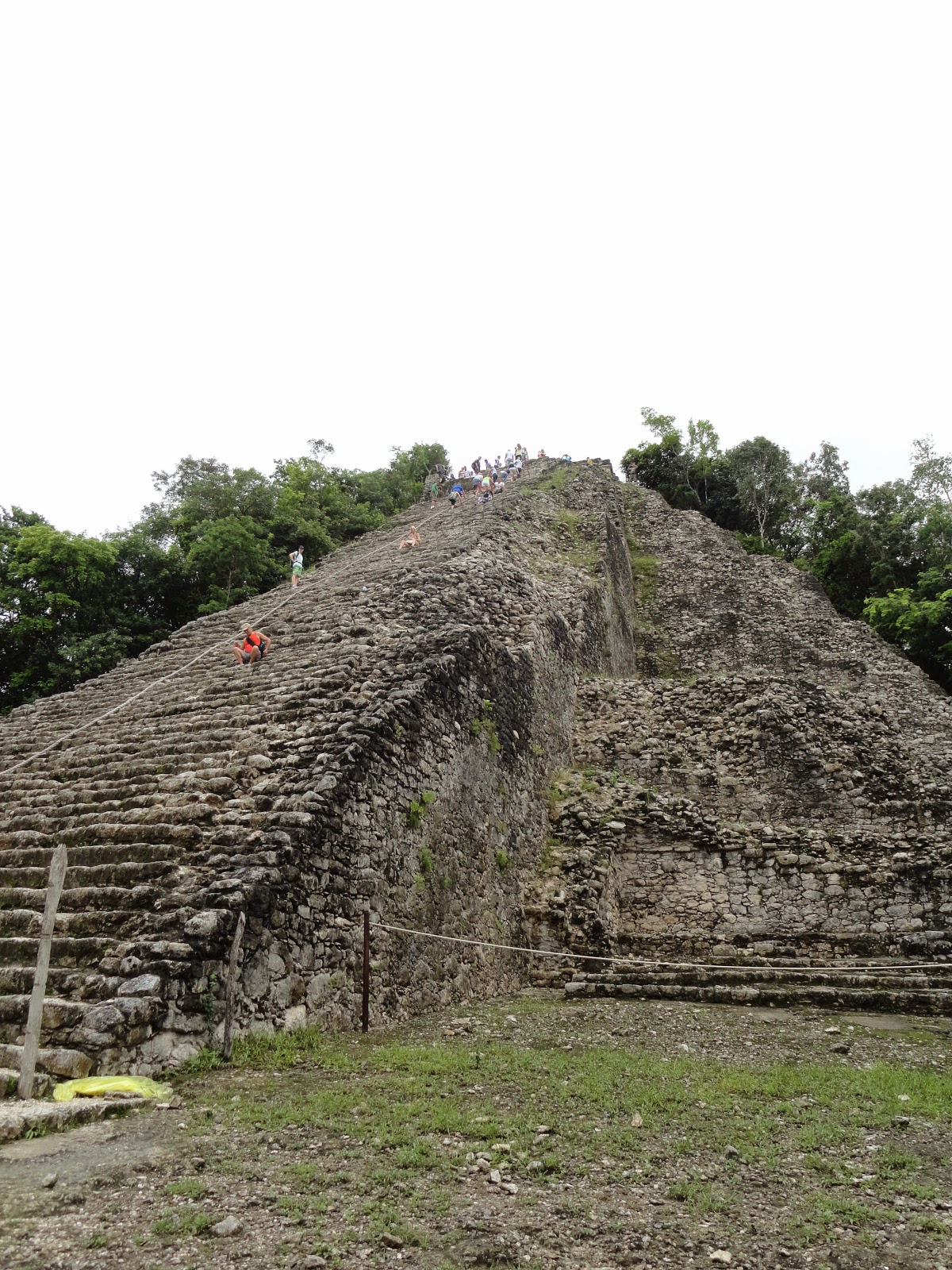
Coba is famous for having the tallest pyramid in the Yucatan peninsula. It's 138' high with 130 steps. Some of our group counted steps and I think came up with 120, but there were a few places with a kind of half step. It's one of the few pyramids tourists can still actually climb. You can see there is a rope up the center if you feel the need to prevent yourself from tumbling down.

Looking down from the top. I am terrified of heights, but I actually didn't feel too uncomfortable climbing this pyramid. It felt a little like climbing a mountain.

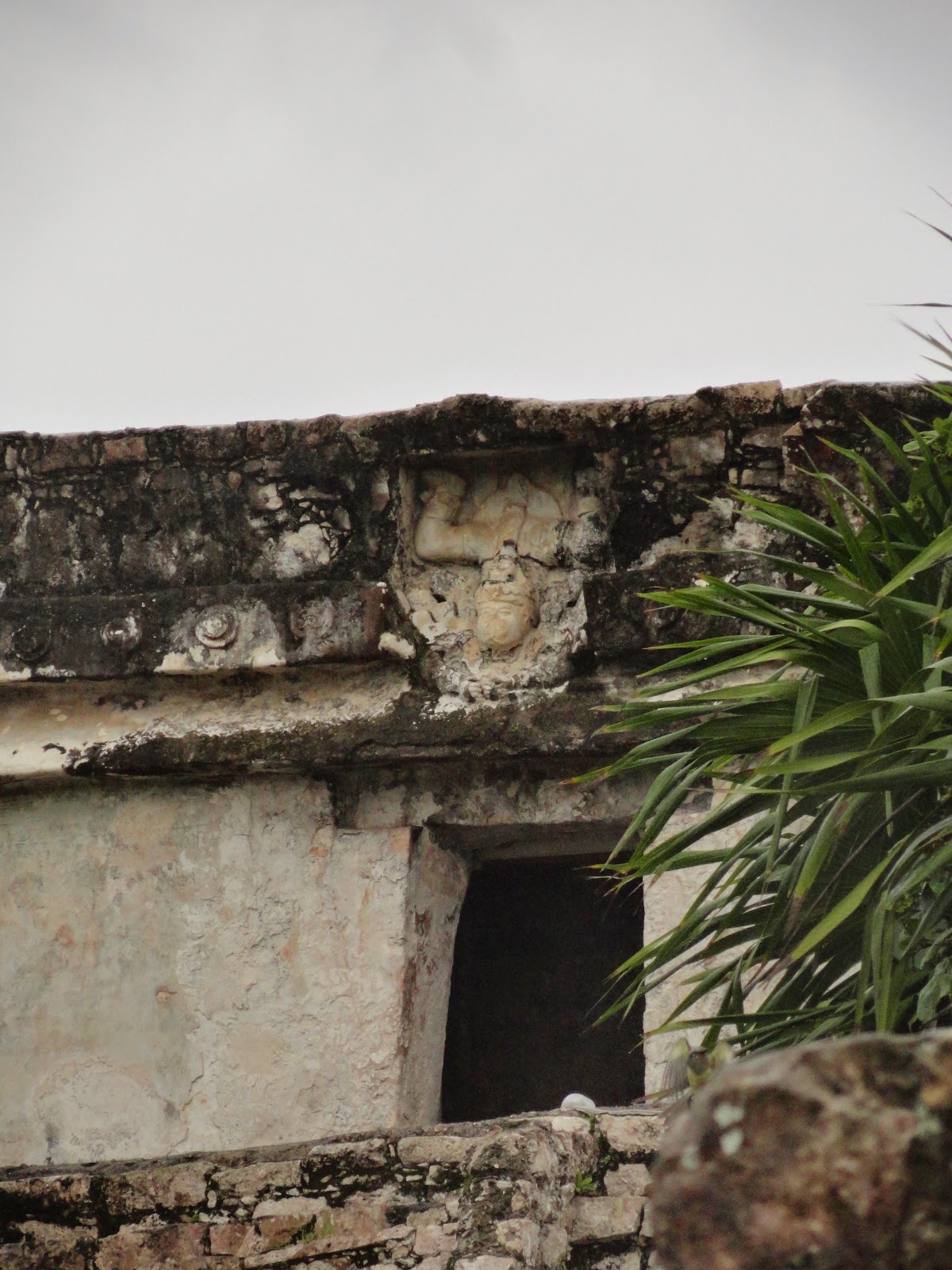
The top structure of this pyramid has a couple of depictions of the descending god.
This one:

and this one:

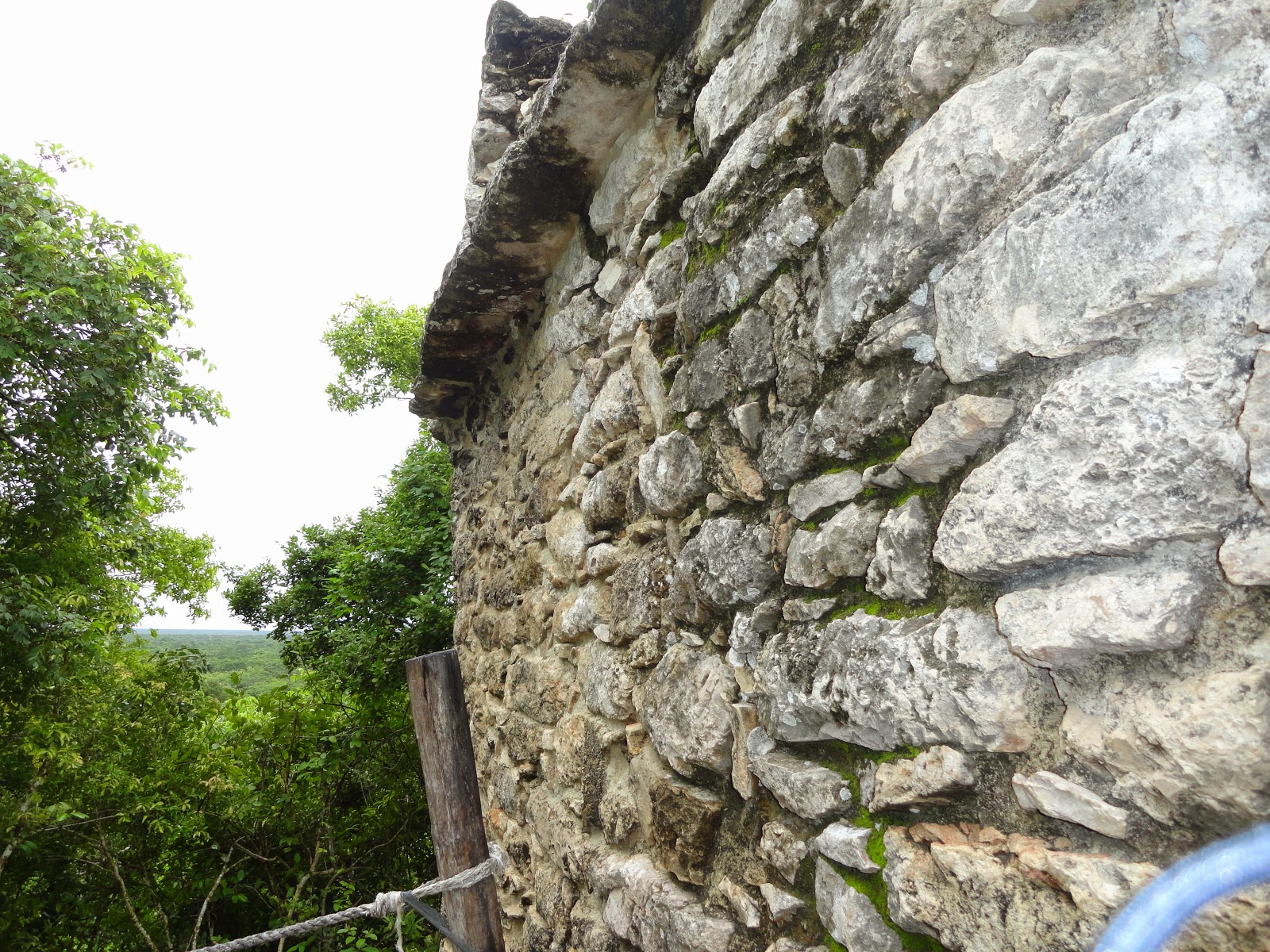
Looking at the side you can see how much the jungle encroaches on everything here.
Proof we made it to the top.

What goes up most go down.

Another pyramid, visible from the top of our pyramid, that has been swallowed by the jungle.

The pyramid from a bottom angle.
This round house with reminded me of a beehive. The four levels of the house are to represent the four seasons and the cardinal directions.

Trees were growing right through the stone steps. It must have been a chore for the ancient Mayans to keep the jungle back.

These are tough trees.

Yellow-throated euphonia hiding in the tree.

This tree would not survive in Billings. Those poor, exposed roots would freeze in a Montana snowstorm minute.

Of course, the thatched roofs we saw everywhere wouldn't last long either. They do seem to withstand the rain quite well.

We saw this feature a few times- a long, short tunnel running under a building.

I'd love to bring him home and use him for a Halloween decoration.

This was likely a house. Remember, these structures would all be stucco covered and brightly painted.

A young fossil looking at the old fossil.

We left Coba and headed for lunch at a Mayan village. Along the way, we saw several private homes like these (taken through our van window).

We ate the most delicious Mayan lunch. I wish I had pictures of the simple foods: rice, beans, tortillas, chicken, squash along with a couple of fruit juices, one from hibiscus flowers, one from a local fruit. We were asked to leave our cameras behind at this point so that we could be forced to buy the expensive photographer's pictures so as not to get tangled up in our next adventure.
.JPG)
We paddled ourselves across a little lake,

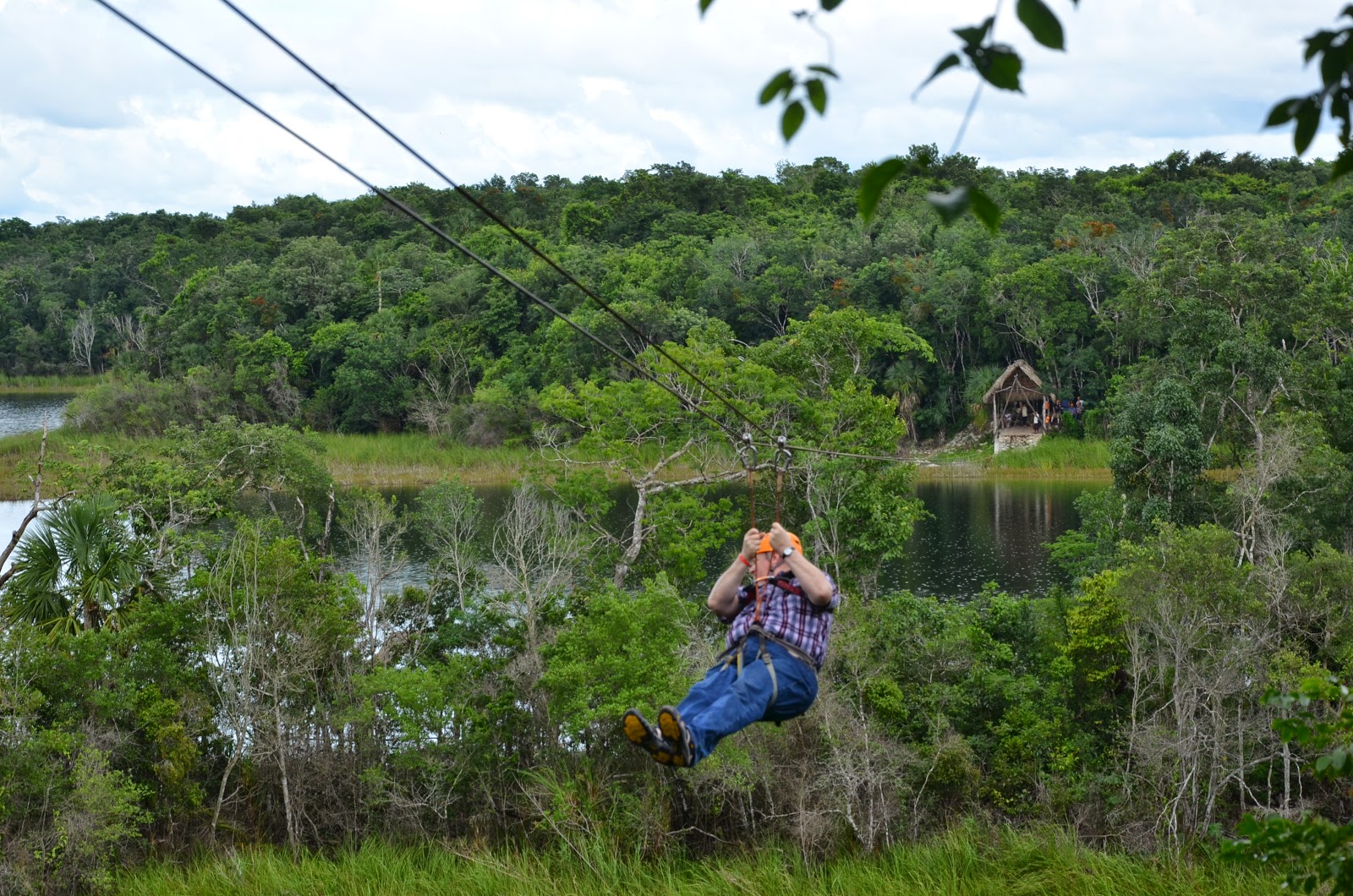
donned these adorable helmets and zipline gear,

and climbed the trail to our death our adventure.

We zipped down twice, the first time facing backward (so as not to freak out?).

Yeah, that guide looks a little too excited to send Stan to his death.

It was pretty fun stuff!