Tuesday, July 4, 2017

February 2017 Part Two The Tale of Two Presidents

No visit to Dallas is complete without a visit to the Texas School Book Depository, a seven story building built in 1902.  This infamous building has been restored to its 1963 glory, and is now a museum of the time and circumstances of the Oswald assassination of Kennedy. The Depository is on the sixth floor. Other floors are used for city offices.  

There were no pictures allowed in the Depository, so I found some online. The Depository corner window area looked much like this on November 22, 1963. There had been an oil spill and many of the boxes had been moved to this area while clean-up was going on. In addition to this room, there were a number of exhibits describing the shooting, the aftermath, and information about Oswald. 

I thought I knew everything there was to know about the Kennedy killing, but I learned a lot at this interesting museum. For example, Oswald was only 24 when he killed Kennedy, and as he left the building after the shooting, he was stopped by a policeman, searching for the shooter. Oswald's boss identified him as a worker, someone who belonged in the building. Both the policeman and boss later said Oswald was so calm when stopped they couldn't believe he was involved. He worked in the Depository, earning $1.25 an hour.

After leaving the building we walked to the spot, marked by an "x", where Kennedy was shot. 

Here is the same spot in 1963, taken from the Zapruder film.

This is the area of the "grassy knoll", a slight incline originally owned by John Neely Bryan, the rounder of Dallas.  He later donated the land to the city.

 Looking back at the Depository corner window, second from the top,
 the spot from which Oswald shot Kennedy.

We walked to downtown, passing this little house.  It turned out to be an early cabin, built in 1842. Moved and rebuilt in several places, it was finally settled on this spot, the place Bryan originally lived and donated for use as the original courthouse. Bryan came to Texas in 1839, looking for a good spot to set up a trading post. The post idea fizzled out, but Bryan stayed and established the city of Dallas. He would have built a cabin very similar to this, but all original log cabin homes in this area burned and were rebuilt with bricks. It's hard to imagine this tiny cabin housing a family.


He became postmaster, a store owner, a ferry operator, and was instrumental in having the city surveyed and plotted. He donated land for government use, married and had five children, participated in the gold rush, shot a man (not fatally) who insulted his wife, became a local political figure, and saw to the needs of the less fortunate. He was a colorful man who died in an insane asylum in 1877 at the age of 66. 

Our next stop was the George W Bush Presidential Library and Museum. It was opened in 1913 on the campus of Southern Methodist University (SMU).

This is the first Presidential Library I've been to.
I love this simple, heartfelt tribute to Bush's dad.

As I wandered around, I was struck by the messages 

and displays. It took me awhile to figure out what was so different here. Finally it dawned on me that every single thing in this museum was glowing in tone and message, totally positive.

Even the horrible, evil 9/11 display highlighted Bush's strengths. I've got to be honest, Bush wasn't my favorite president, but I enjoyed this upbeat depiction of his presidency. I came away liking him a whole lot more.

One of my favorite Laura dresses.
 

I gift painted by and from Ted Kennedy to Laura Bush acknowledges her influence on education. He signs off "your friend". Seriously, it's heartwarming to know that even opposing politicians can acknowledge the good in others. In the age of Trump (also not one of my favorites on a whole other level), it's good to see this expression of sincere appreciation. And the painting is quite good.

 We stopped by the Oval Office to chat with the prez,

and enjoy the view (Wait! Where's the Rose Garden?).

We admired the desk, a copy of the Resolute desk used in the White House. The Resolute desk was a gift from Queen Victoria to President Rutherford B. Hayes in 1880. Franklin Roosevelt modified it with the presidential seal covered center panel to conceal his leg braces. The name "Resolute" comes from the source of the oak timbers used to make the desk. Resolute was a British Arctic Exploration ship. 


Finally, we got an audience with President Jones. It didn't last long.

He had to take a call from Putin. We've been told President Bush occasionally stops by, but we didn't see him today.

 The Library/Museum is full of gifts given to the president, like this lion from Tanzanian President Jakaya Kikwete during Bush's trip to Africa in 2008 ("Honey, where should we put the lion?" "I don't know George, but it's not staying in the bedroom!")

There were several displays of gifts from foreign countries, full of beautiful, weird, or unusual presents to the "American people". This struck me as an odd custom. Beautiful creations, stuck behind glass, seen by only a small percentage of "American people".

 Some of my favorites: pet dishes for dogs Miss Beazley, Spot, Barney, and India, the cat.

 This impressive necklace from Africa. It is huge, very intricately detailed, and probably weighs a ton.

Look at its size in comparison to the other necklaces in this case.

This silver and gold craving of the city of Jerusalem has a liahona-esque feel to it.

I feel I can say with a great deal of authority that Montana is never going to house a Presidential Library.  I'm delighted to have children who live in interesting places to go visit. I'd come just to see the grand kids, but don't tell them that.

Saturday, July 1, 2017

February 2017, Part One

When we returned from our time in Fort Collins, we were welcomed back 
by some of my favorite peeps.

Whether they are rearranging the furniture,

or preparing for a party, they are always entertaining.

Despite Brinlee's unhappiness with her recent school change, she snagged the award for bravery this month at school. After all, it takes courage to walk uphill both ways in a snowstorm to go to kindergarten.

There just isn't enough noise and chaos in my life. Time for Hailey and Makayla to do a few overnighters so that Amy can pick up some hours at her second job working at the Metra.

I've enlisted by four favorite flourishing artists to paint a Valentine's sign for me.

 I assigned each of them a letter.

I told them they could paint any design in pink or red that they wanted to.

They did a lovely job, brushing on an astounding amount of paint 
that should take only a few years to dry. 

I sped up the drying process with my hairdryer and viola! A keepsake objet d'art from my grandkids.


However, I'm not feeling a lot of love here in Billings. Snow continues to pile up and up and up.

While temperatures have climbed slightly, I can't help but admire what's going on in Dallas.

Yeah, we should head to Dallas where the flowers are blooming

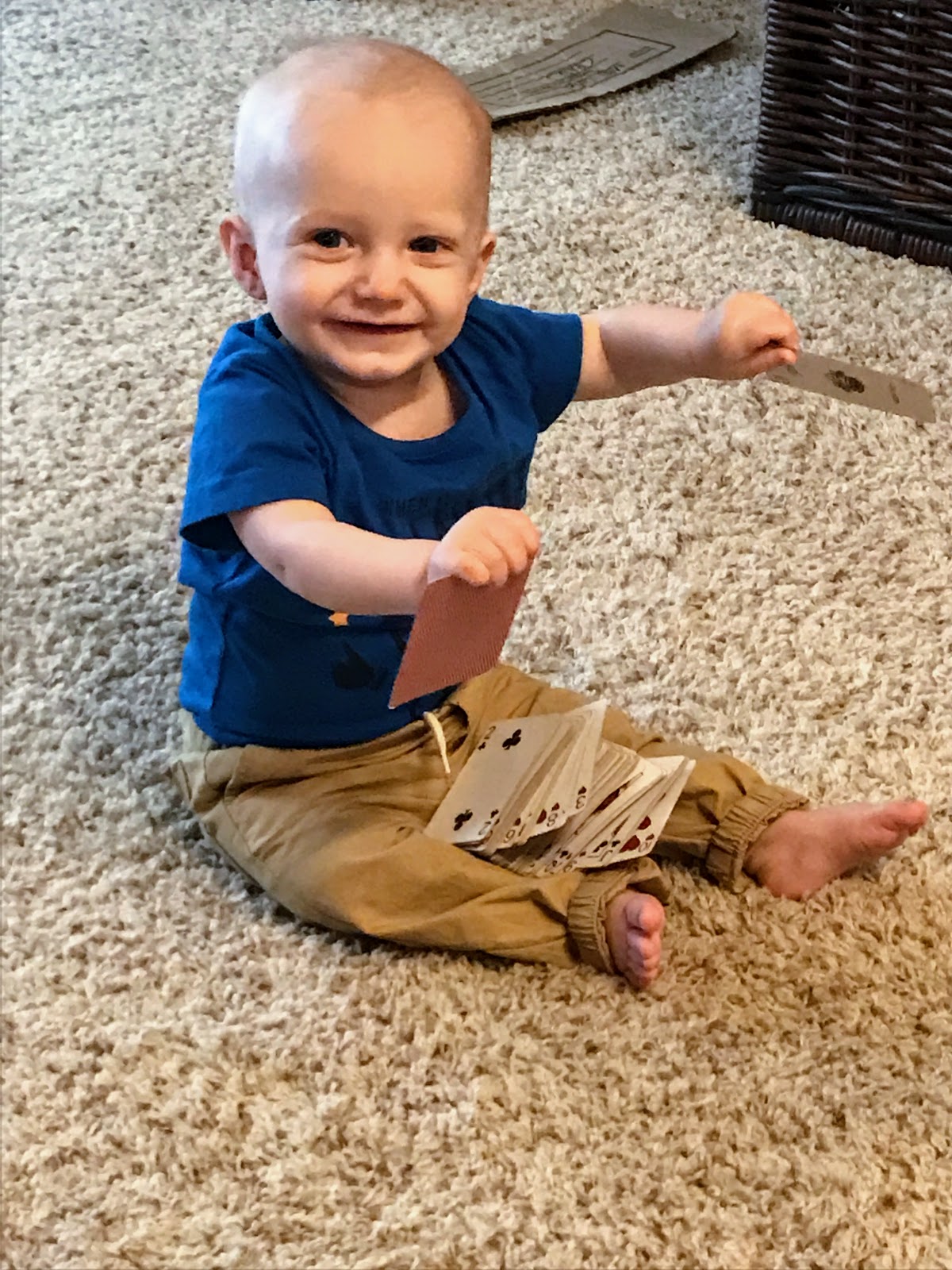
and the littlest Butler is growing up without me.


This cute guy is the happiest baby ever.

He's also the most vocal baby I've heard in a long time, constantly "talking". 
He is a delight to be around.

We headed to downtown Dallas on our first day.

We decided to take a look at the Dallas Museum of Art. I wasn't expecting much--how impressive could free museum be? 

As it turns out, very impressive. Even Mr. Happy was delighted to be here.

This Museum has an astonishing variety of art, like 
 the Two Walking Figures Pushing a Stroller, located to the right of  Henry Moore's Two Piece Reclining Figure, No. 3. Henry Moore was a British artist born in 1901 who sought to "emphasize the importance of space as a vital sculptural element". 
Yep. That's what I was going to say.

The museum had a large collection of modern art. Is this a giant version of the Tinman's hat?

I have no idea what this is. Some of the art had signs nearby with the name of the art and the artist. This one didn't.


 Self-Portrait Next to a Colored Window, 1964 by Jim Dine.

This appears to be the drop cloth from the above picture?

This is Dancing Duke by John Chamberlain. Hmm. 
I thought this was Winter Driving in Montana.


 This 1917 Piet Mondrian painting is entitled Windmill. Yeah, I'm surprised by that name, too.  I think this is more to my taste than the previous Dancing Duke.

Here's one that's instantly recognizable: Water Lilies by Claude Monet. This painting is one of 48 done in 1908-1909 for an exhibit in Paris. It is one of only four circular paintings ever done by Monet.

I few more that caught my eye:
Forest of Fontainebleau by Narcisse Diaz de la Pena, 1868.


 Ecce Homo by Giulio Cesare Procaccini, 1615
This painting depicts Pontius Pilate looking toward the beaten Christ, who is presented to the people of Jerusalem before the Crucifixion. Likely painted as an altarpiece for a Genoa church. 

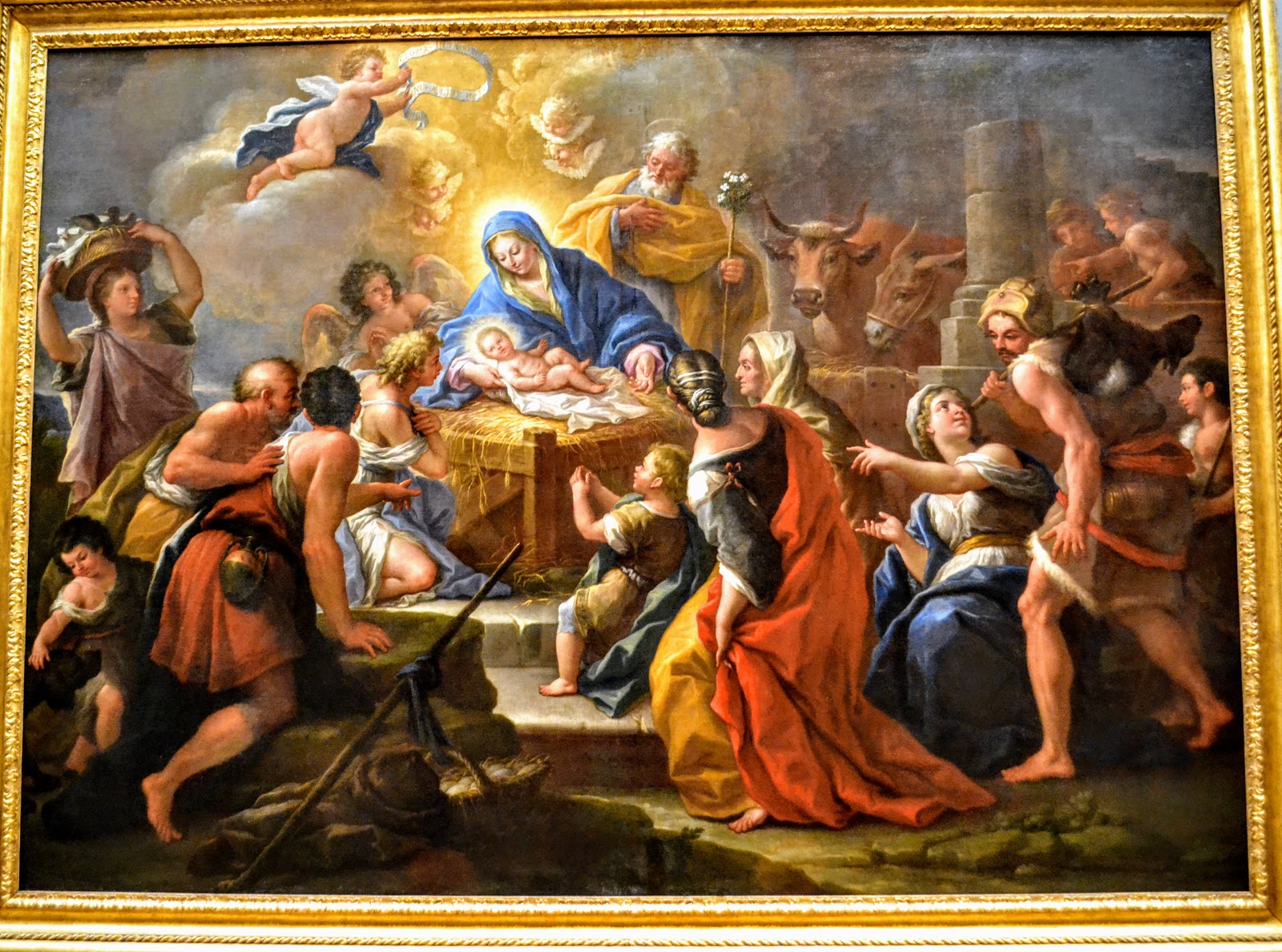
 The Adoration of the Shepherds by Paolo de Matteis, 1680-1628. Also likely painted for a church or a chapel. This painting hung for nearly 50 years in the palace of the Torre Tagle family in Lima, Peru.


In addition to modern and traditional art, there were a lot of ancient artifacts.  I've learned that these ancient works of art are plentiful in other parts of the world, and can be viewed in museums throughout the world. The Dallas Museum had a spectacular collection of Greek, Roman, and Egyptian art.

This is Figure of a Young Man From a Funerary Relief, made in Greece in 330 BC. This grave memorial depicts the young man who died; 

These remnants are incredibly life-like. 

This is known as a "Volute Krater", a red-figure vase made in 340-330 BC. It was designed for burials of Greek nobles. The scenes on the vase represent funerary ceremonies. This side shows a dead man being presented with a wreath.  Volute refers to the round handles, and a Krater is a vase used to water down wine. The faces on the handles ward off evil.


 This Egyptian Mask was made in the late 2nd century,  It would have been placed over the face of an embalmed body. This mummy mask was made for a Roman woman in Egypt. She would have adopted the religion of Egypt, hence the Egyptian mummy mask with Roman features. 

Contrast the previous mask to this more traditionally Egyptian mask from around the same time period.


 The large collection of gold jewelry dates from 7th century BC to 2nd century AD. It's mainly from the enormous amounts of uncovered graves. Gold was plentiful enough that it was usually sent to the next world with the deceased. Most of it looks very modern.


Everyone needs a gold olive leaf wreathe crown to wear into the next life.


 This early 1st century BC bronze is Eros Lamp Holder.  The Greek god of love is shown with both male and female characteristics. The outstretched hand with the tendril would have held an oil lamp. This is a piece that would have been made for a wealthy Mediterranean home and was recovered from a shipwreck. Looks like the fishes have been nibbling his/her toes.

Syrian limestone Head of a Priest, 150-250 AD


 Roman sarcophagus from 2nd century AD. The sarcophagus depicts battle scenes, a common theme of this time period. The man buried in such a sarcophagus would have wished to identify his life and career with these scenes of military triumph. 


This amazing museum had all kinds of unique creations, like this 1771 mantel clock with figures of France and Mars atop a 1780 secretarial desk made of 7 kinds of wood as well as leather, metal and marble.

 I like this 1790 Running Bacchante by Clodian. The museum has both the male (which I never found) and this female statue. No word on why she's in such a hurry.

 Here's my favorite masterpiece.

This somehow reminded me of the ten commandments. It's actually a tomb marker, full of Chinese writing describing the 45 year old woman who died. It dates back to 1000-1200 AD. Tortoises are important in Chinese culture, symbolizing north and winter, as well as longevity.

 This wooden house door is from Indonesia, dating to 1915.  I wonder what my neighbors would think if I added this to my house?

 Nigerian shrine statue representing a hero village founder, made sometime between 1875-1890

 This and the following picture are masks from late 1800 Congo.

They were used in ceremonies, initiations, and funerals.

From 14th century Indonesia, Ganesha is a god whose father cut off his head. Later, he restored Ganesha with the head of the first thing he saw-an elephant. Yep, that seems fair. But he looks pretty happy, and he is one of the most beloved gods.

 A Tibetan Initiation Crown from the 18th or 19th century. It looks a lot like a creepy Halloween prop.

 This 19th century or earlier funerary figure is from Indonesia. Her open mouth and expression is believed to have indicated she was an aristocratic woman used to public speaking and giving orders. Or maybe she's used to bossing grand kids around.

I was enjoying these detailed Asian dancers, when I nearly had a heart attack as  

a scary figure slowly arose between them.  Geez Louise, Megan, stop that!


While we are enjoying the sights and warmth of Dallas, I find myself wondering what's going on at home.  After requesting an update, I got these pictures:

Here's Hailey, one of six artists chosen from her school for a special exhibit.  Her class's assignment was to draw a selfie. Clearly, all those years of Grandma's art school have paid off. Good job, Hailey!

I also got this update from home. Hmmm, still snowing, still cold.  I think we'd better stay in Dallas a little longer.
Maybe we should stay forever.